|
Forget fancy phones and gizmos scientists are now
hailing the humble paper clip to plastic holders for beer cans as the
design classics that we cannot live without. They’re the inventions that
don’t get much limelight, but make a huge difference to our everyday
lives.
|
 |
Bubble Wrap - It started off life in the 1950s as failed wallpaper, then
greenhouse insulation, before being branded by its inventors Alfred
Fielding and Marc Chavannes, who formed the company Sealed Air
Corporation. Even then it took a few years before its destiny as
protective packaging was revealed when IBM used it to safeguard computer
deliveries.
|
 |
Paper clip - American Samuel B Fay was awarded a patent for the paper
clip in 1867. It was triangular in design and was eventually trumped by
the Gem paper clip first advertised in 1894. Its design is still used
today. A Facebook page called Can this paper clip get more fans than
Miley Cyrus? has so far fallen short of its target, having only mustered
13,000 fans. Singer Miley Cyrus has 16 million.
|
 |
Rubber band - One of England’s greatest inventions, the rubber band was
patented by Stephen Perry in 1845. It’s been loved by post men and women
the world over ever since. The Royal Mail now uses red rubber bands in
the hope that because they are easier to spot, it will encourage staff
to pick them up if they’re dropped. The company uses around 342 million
red bands a year to keep our letter and parcels in neat bundles.
|
 |
Tin can - We’ve got Napoleon to thank for the humble tin can. He was so
fed up with his soldiers being weakened through malnutrition that he
offered 12,000 francs to anyone who found a solution. Nicolas Appert
answered the call of duty in 1810 and produced air-tight wrought-iron
containers that scooped the prize. However, in those days there were no
can openers so soldiers had hack at them with swords or smash them open
with rocks. Britain produces more than 20 million cans a year.
|
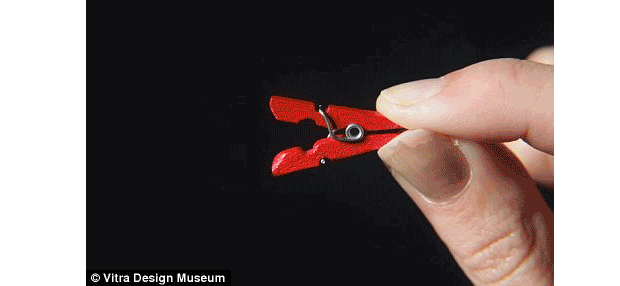 |
Clothing peg - David M Smith sprung into action and invented the
spring-type clothes peg in 1853, after Jérémie Victor Opdebec had
rustled up the single-slat wooden clothes peg a few years before. In a
testament to its brilliant simplicity, the design has barely altered.
|
 |
Coat hanger - In 1904 American Albert J Parkhouse had a flash of
inspiration upon seeing an overcrowded coat rack at work – he grabbed a
piece of wire and made what we now know is a coat hanger. His invention
was a versatile one. Some people use them as radio antennas, crooks have
used them to break into cars and in 1995 a doctor sterilised one with
brandy and used it to perform emergency surgery at 35,000 feet on an
airline passenger who’d suffered a collapsed lung.
|
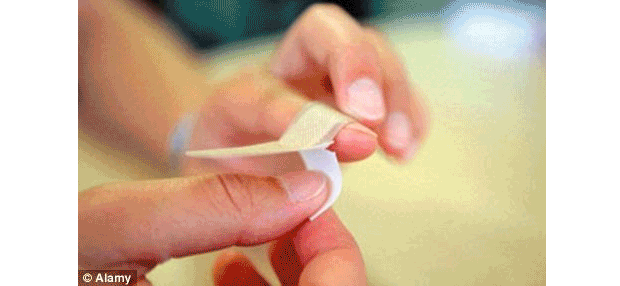 |
Sticking Plaster - It’s bleedin’ obvious how useful these are – and we
have a Johnson & Johnson employee from 1920s America called Earle
Dickson to thank for them. He began using plasters – used back then to
mend bicycle punctures - to cover up the minor cuts his wife would
suffer while cooking and told his bosses how well they worked. Johnson &
Johnson marketed them as Band-Aids.
|
 |
Egg box - The U.S. takes the honours for the humble egg carton. Back in
1911 a newspaper editor called Joseph Coyle from British Columbia was
called upon to mediate a dispute between two local yolk-els – a farmer
and a hotel owner who complained that his eggs were always being
delivered broken.
|
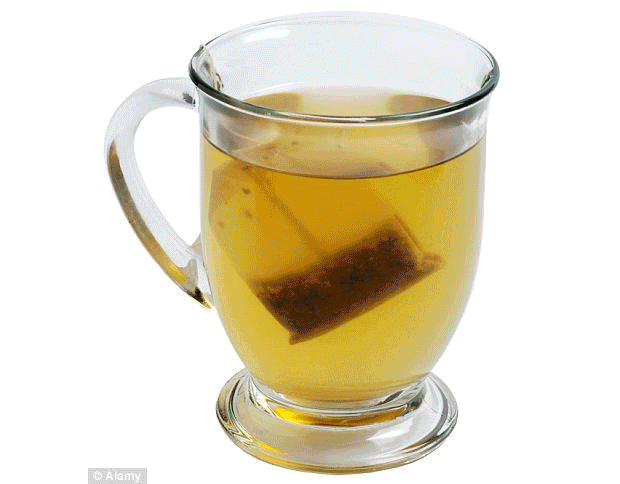 |
Tea bag - Agonisingly for tea-loving Britons, it was actually a New
Yorker called Thomas Sullivan who first marketed tea bags in 1904. It’s
thought that the idea was inspired by customers dipping unopened packets
in hot water to test tea shipment quality.
|