|
Montréal, in the south-west corner of Québec
Province, is situated on the largest of the 234 islands that form the
Hochelaga archipelago in the St Lawrence River. The heart of the city is
the Île de Montréal (158 sq. km (61 sq. mi.)) at the confluence of the
Ottawa River and the St Lawrence, which also takes in the slopes of the
ancient volcano of Mont-Royal, or Mount Royal (238 m (260 ft)), the
mountain park in the city centre.
There are eight hills in and around Montréal, peaking as high as 527 m
(1730 ft), the remnants of Ice-Age Devonian volcanoes.
The city actually gets its name from one of the hills, the Mont-Royal,
and nowadays a very popular park with a view. Jacques Cartier landed
here in 1535 and took the territory for his King, François I of France.
Officially founded in 1642, Montréal is one of North America's most
important cities. Not only is it the second biggest city in Canada, it
is also the second largest French-speaking city in the world.
|
|
 |
|
Located as it is on the St Lawrence Seaway, the city has prospered since
the 18th c. as a hub of communications and trade, a port of call for
seagoing vessels from the Atlantic and the waterborne traffic along the
St Lawrence and westward to the Great Lakes. It also has its share of
administration and academic life, and is the seat of the bishopric.
Having also won itself a high international profile with the Expo in
1967 and the Olympic Games in 1976, in 1992 Montréal celebrated the
350th anniversary of its foundation.
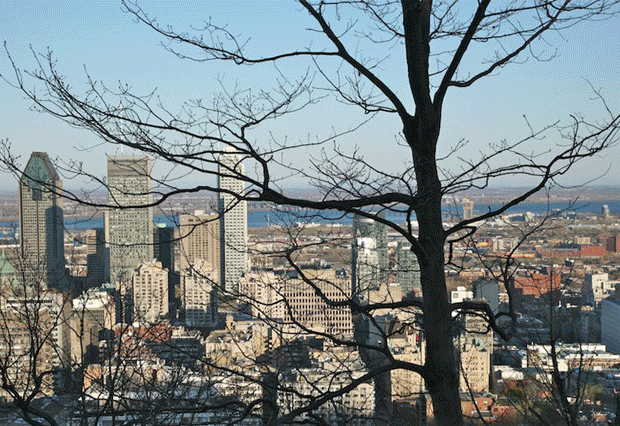
An impressive view of the city is to be had from Mount Royal or one of
the skyscraper viewing platforms. Another way of enjoying the city
skyline is from a boat trip on the St Lawrence.
|
|
|
|
Montréal's climate swings between the extremes of high humid heat in
summer and heavy snowfalls in winter. The average temperature in January
is -10°C (14°F), and -20°C (24°F) is not unusual. In July the
thermometer hovers around 22°C (72°F), occasionally reaching 30°C
(86°F). Mean precipitation over the year is around 750 mm (30 in.).
Montréal's population growth has always tended to be dominated by
immigration, whether from overseas or elsewhere in North America. This
was at its highest between 1851 and 1861, and 1951 to 1961. The city's
population in the 19th c. was 82 per cent British and French in origin,
but since the second half of the 19th c. it has been overwhelmingly
French-Canadian. At the turn of the century there was an influx of Jews
from Eastern Europe, followed by Southern Europeans. In 1971 the city
had 64 per cent French Canadians, 11 per cent English Canadians, with 25
per cent ethnic minorities including Jews and Italians as the largest
groupings, followed by German, Poles, Ukrainians and Dutch, Greeks and
Portuguese, as well as Asians and Afro-Caribbeans. The number of
inner-city dwellers has fallen sharply in recent years as many have
moved out into the suburbs, and this exodus from downtown Montréal, and
from elsewhere in Québec Province to suburbia for that matter, is
continuing. While many small ethnic minorities get along with one
another in the everyday way of city life, this is not the case with the
French and English Canadians, for whom the gulf between their cultures
seems as wide as ever, and the demands for autonomy of Canada's
French-speaking population have intensified considerably in the recent
past.
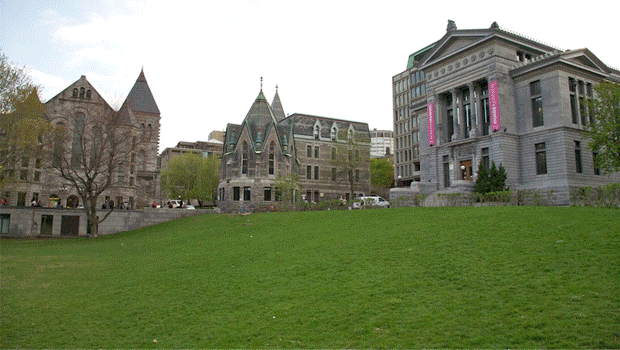
When Jacques Cartier, on his 1535/1536 voyage of discovery, was the
first European to set foot in what is now Montréal, he found an Indian
village of some thousand souls, called "Hochelaga" by the Huron, just
below a hill (where McGill University stands today), which he named
"Mont Réal", the royal mount, in honour of his French king. It was
almost three-quarters of a century before the territory was visited
again, this time by Samuel de Champlain, the founder of Québec, who came
here in 1603. He found no trace of the Indian village, and in 1611
established a short-lived trading post called "Place Royale".
|
|
|
|
Another 30 years later Paul de Chomeday, the godfearing Sieur de
Maisonneuve, founded a small mission station here in 1642. Called Ville
Marie de Mont-Réal this was the original settlement that today is
Montréal. He had accommodation built including a chapel and a hospital,
run by Jeanne Mance, and built a palisade around it as protection
against the Indians. Their conversion to Christianity was the object of
the missionaries, foremost among them the Congrégation Notre-Dame and
its Mother Superior Marguerite Bourgeoys, and the Compagnie de Saint-Sulpice,
who had been given the Seigneurie of the Île Montréal in 1663 by the
French king. By 1672 Montréal's population had grown to about 1500, the
figure it remained at till the end of the 18th c.
In the comparatively calmer times following the peace treaty with the
Iroquois in 1701 Montréal profited from its role as a centre of the fur
trade, and farming began in the country round about. The burgeoning
disputes between the British and the French finally erupted into war in
the mid- 18th c. when the British succeeded in taking the city without a
fight in 1760. During the American War of Independence the American
revolutionary troops besieged the city briefly in the winter of 1775/76,
but withdrew when its people sided with the British, refusing to take
part in the Americans' fight for freedom.
In the time that followed Montréal benefited from an influx of
Loyalists, fleeing from an America no longer loyal to the king, and from
growing numbers of British traders, mainly Scots and Irish, who together
formed the North West Company, stepped up the fur trade, and set
Montréal up as an important trading post and rival to the Hudson's Bay
Company. By 1792 Montréal's population, at about 6000, was enough to
give it township status.
A further boost came with the opening of the St Lawrence to steamer
traffic in 1809 and completion of the Lachine Canal in 1825, allowing
shipping to get from the Atlantic to the Great Lakes. Population numbers
soared from 22,500 in 1825 to 44,000 in 1844 as immigrants flooded in
from Great Britain. A dynamic business community invested heavily in
timber and shipbuilding, then in import/export, and, after 1836, in
railways and all the ancillary trades. Montréal became the most
important centre of commerce, as well as an arena for social tensions,
not only as between capitalism and the workers, but also between
French-speaking and English-speaking factions as they struggled for
political supremacy.
|
|
 |
|
The Anglophile middleclass gained the upper hand with the defeat
inflicted on the French patriots during the 1837 uprisings only to see
their privileges swept away after 1867 as the French-speakers came to
dominate the population. For a time, between 1844 and 1849 during the
Canadian struggle for unification, Montréal became the capital, only to
lose this status after the Parliament building fire during the unrest of
1849. Growing immigration from eastern and southern Europe meant that
after 1900 the city became an even richer ethnic mix, its population
soaring to close on 470,000 in 1922.
The boom for industry, trade, transport and financial institutions that
followed the First World War gave way to the deep depression of the
Thirties, when three-quarters of the million working population were
forced on the dole, causing the collapse of the city budget.
The recovery, when it did come, was after the Second World War, when it
was due to high demand from abroad and cheap immigrant labour, together
with an army of refugees from rural life streaming into the cities.
Montréal's economy received another boost from the joint venture with
the USA to build the St Lawrence Seaway. The post-industrial era began
in the Sixties with the demolition of much of the old centre of Montréal
in order to construct the subway system, and massive expansion of the
services sector. Giant multi-purpose building complexes sprang up while,
below ground, a whole new town was built as a shopper's paradise, away
from the harsh extremes of the Canadian winter. In fact there was
virtually nothing that needed doing to improve on the already ideal
business conditions. But all this actually had the opposite effect. The
enormous infrastructure costs drove up prices, and this, together with
political decisions to go for an independent French-speaking Québec, had
industries and corporations in the 1970s moving away in droves to set up
their headquarters in Toronto, where the business climate was better.
Since then the two cities, Toronto and Montréal, have been vying for the
position of Canada's business capital. |