|
Google co-founder Sergey Brin believes that
"self-driving cars will be far safer than human-driven cars" but who
trusts them enough to drive in them or even alongside them? Drivers will
not need a driving licence by 2040. At least that is what the Institute
of Electrical and Electronics Engineers believes. It thinks autonomous
cars capable of driving to any destination are set to become the norm.
With an estimated 90% of current car accidents thought to be caused by
human error, taking people out of the equation is seen by many car
companies as a massive boost to safety.
But most qualified drivers do not seem to think they would be the ones
in trouble.
"Most drivers think they are better than average drivers," says
psychologist Dr Graham Hole, of the University of Sussex, who has
published work on the psychology of driving.
"People typically have a very inflated view of their own abilities as
far as driving is concerned."
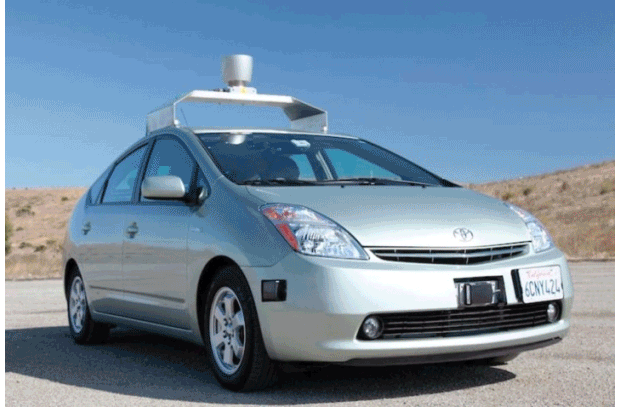
A large number of companies are investing in autonomous driving
technology.
|
|
 |
|
General Motors, Volkswagen, Google, Volvo, BMW, Audi, Mercedes and many
more are all in vehicle autonomy trial stages to a level not seen
before.
But who is a better driver - man or machine?
And if there is a clear winner, how are drivers - or technical experts -
convinced of the findings?
In the US in 2010 - 32,885 people died in motor vehicle crashes - the
lowest number on record for more than 20 years.
This is the equivalent of 1.11 fatalities for every 100 million miles
travelled on US roads, according to the US National Highway Traffic
Safety Administration.
It will take Google 300 million miles of driving without fatal incident
- Bryant Walker Smith, of Stanford Law School, believes - to prove that
autonomous cars are significantly safer.
But even if these figures are proved to be true, we will still take some
convincing before we hand over control to a computer. Psychologists
believe people are more scared of things not under their direct control,
pointing towards the fear of flying, nuclear power and even food
preservatives.
'Crash dummy'
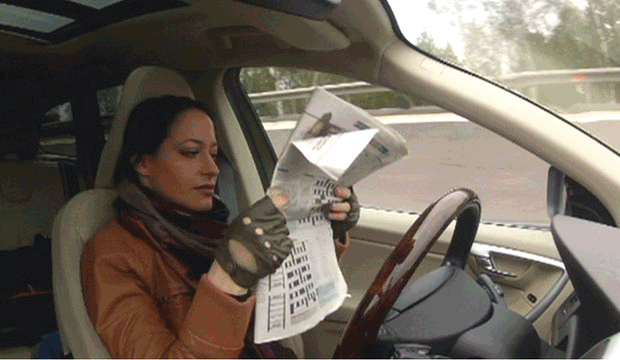
Volvo, current manufacturer of the safest car tested in Europe, is
currently involved in the autonomous project Sartre, testing a "road
train" where, on motorways, cars are linked to a head driver and then
can relax, read the newspaper or, as Click found out, play a musical
instrument.
The car is only 6m behind the one in front, around 0.25 seconds at the
speed tested.
"Six metres apart when you have to control the car yourself would be
uncomfortable," says Eric Chan, chief engineer of Ricardo, the UK
company leading the Sartre project.
"You can barely see the lane markings, you can't really see any stretch
of road between you and the car in front."
For the current driver, questions have been raised about how comfortable
the person in the driving seat would be when they are not doing the
driving.
|
|
|
|
Even some psychologists are worried about the absolute security of
having a computer in control.
"The reality of the situation is that driving environments are very
complex and they involve all kinds of decisions to be made - from
strategic levels to the operational level of collision avoidance," says
Dr Hole.
"Human beings have their faults but are extremely good information
processors, much better than any machine at hazard protection."
Now the term "computer crash" is being coined to describe what could
happen.
"I'm not interested in [being] a crash dummy because Google thinks it's
a cool idea," writes technology journalist Bill Snyder.
The engineering and motor companies are hoping that this is just a
matter of time before people warm to the idea.
And projects are keen to point out the number of ways safety is upheld
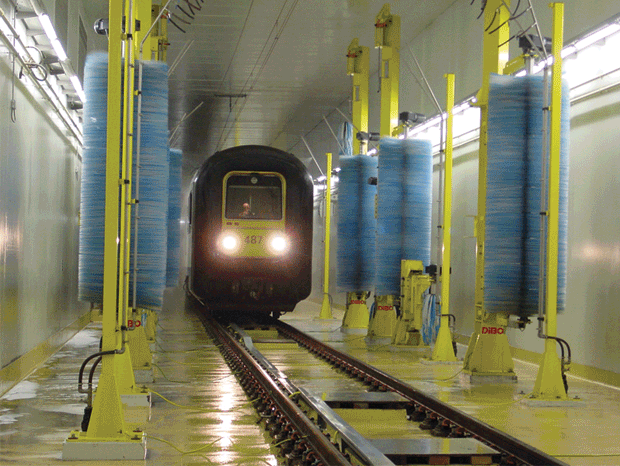
even when a technical failure occurs. For the Sartre project, the system
monitors itself and if something even looks like it could happen,
distances between cars are lengthened and drivers are warned that they
are about to take control.
|
|
|
|
If anything continues then cars are moved to the hard shoulder and
stopped. And Sartre says that it is only one of the ways that a problem
like this could be dealt with.
"It's clear that people will have to get used to this new technology,"
says Chan.
"It changes in a fundamental way your personal relationship with your
car. When seat belts were introduced, when airbags were introduced,
cruise control, there were a lot of people who were nervous about it.
"Over time, people have got used to them and realised the safety
benefits."
Cars on the roads can already park themselves, brake automatically and
alert a driver if they are slipping out of a lane.
So it could just be that these things take a little time.
"The first time I drove a car with cruise control, I didn't like it much
because the car did its own thing," says Chan.
"After a short time, I now use it very often when on motorways. I've got
used to trusting it."
Even the current interest is significant.
|
|
 |
|
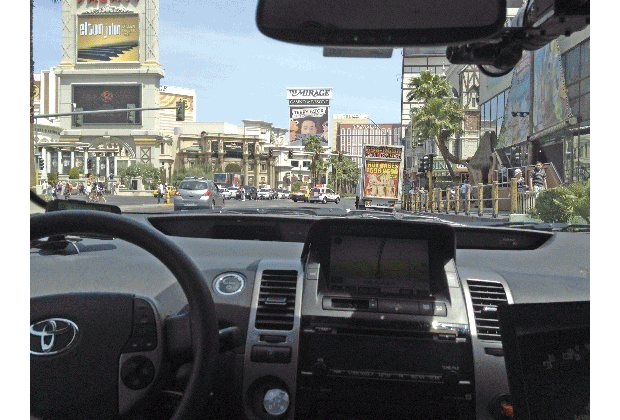
Without driving one, 37% of drivers aged 18 to 37 would definitely or
probably buy a vehicle capable of fully autonomous driving, according to
a JD Power research survey.
But even beyond the safety concerns, those who love driving are not
prepared to start removing their hands from the steering wheel.
"People are less likely to give up control because you just have to look
at the market," says Peter Rodger, head of driving standards at the
Institute of Advanced Motorists.
"There are 70, 80, 90 car magazines on shop shelves bought by people who
like their cars. They actually like the feeling. There is an emotional
attachment that comes with controlling a machine."
And despite Google executive chairman Eric Schmidt's hope that
"self-driving cars should become the predominant mode of transportation
in our lifetime", it could be that even a small risk could be too much
for some people to be comfortable removing the driver completely.
What would happen if the technology fails and no person in the car knows
how to drive?
"Society will find that very difficult," says Rodger. "We are
increasingly a blame culture. When something goes wrong, we look for
someone to pin it on.
"Without accountability, drivers are going to find that harder still."
|