|
When you think about caves, your first thoughts might
not include microbes and antibiotics, but these isolated and starved
environments may hold the key to better understanding our long battle
with drug resistant bacteria.
Antibiotics are chemical keys, constructed to fit the molecular locks
necessary to kill bacteria. They mimic cellular patterns to block, bind
and even collapse critical structures within the cell.
As a result, the bacterium is unable to function, falls apart, or dies.
Antibiotics are also remarkably specific, able to find and target one
bacterial cell in a sea of human cells, without misfiring - the magic
bullet which became the most important medical discovery of the 20th
century.
|
|
 |
|
Chemically, antibiotics are much more complex than anti-cancer or
anti-viral drugs, looking more like a spider's web with their intricate
patterns of chemical bonds.
This complex structure make them almost impossible for chemists to
design or synthesize, which is why we often turn to nature for their
discovery.
Of the myriad of antibiotics that have come on the market over the last
60 years, 99% are derived from other microorganisms, primarily bacteria
and fungi in the soil.
But this source of compounds is starting to run out and we must turn our
attention to more exotic and extreme environments.
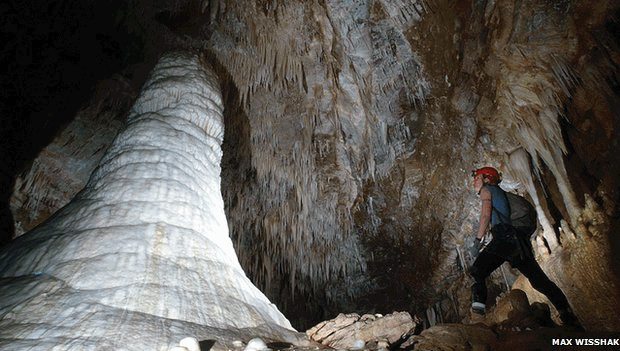
Caves are isolated environments, formed by water eroding rock over
millions of years. In such isolation, without the input of sunlight or
nutrients from the surface, microorganisms have had to adapt to a life
of perpetual famine.
Through my work in caves, I have learnt that such microbes are so well
adapted to starvation, that regular laboratory growth conditions are too
rich.
With many of these microorganisms trapped in an unending search for
food, they are unable to turn off their scavenging systems, and stuff
themselves to the point of death.
|
|
 |
|
Others are so adept at making a living from what little energy is
available that they can survive by eating the plasticizers that leach
out of plastics in our laboratory dishes.
Some cheat, learning to hunt down and prey upon other bacteria to obtain
the resources they need to survive. Of the over 4,000 bacterial species
we have grown from cave environments - 1,000 of which are new species -
most behave unlike their surface counterparts.
What makes these bacteria unique also makes them ideal targets for the
discovery of new antibiotics. In collaboration with Brian Bachmann at
Vanderbilt University, we screened some of these samples for new
antimicrobial compounds.
A single one of our samples produced 38 antimicrobial compounds,
including what appears to be a novel antibiotic. To put this into
perspective, there are less than 100 antibiotics that have ever been
described, and a single isolate from a cave produced almost a third as
many.
So what makes the bacteria in these caves so rich in antibiotic
potential?
The answer probably lies in isolation.
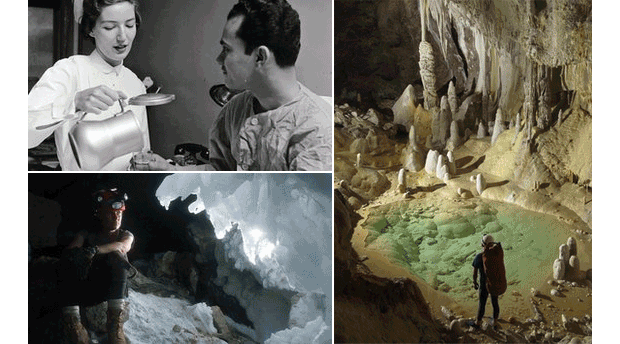
These bacteria were collected from a deep and isolated cave. Lechuguilla
Cave, in New Mexico, USA, is a deep cave, formed over four million years
ago by the action of sulphuric acid from groundwater.
The cave averages over 1,200 feet in depth and requires abseiling down a
dozen ropes to access sample sites. Indeed, sampling often occurs in
areas so remote that we have to camp underground for days at a time.
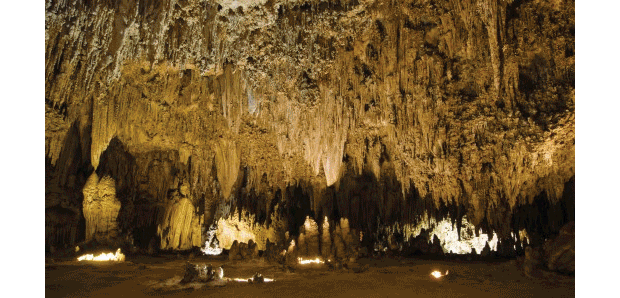
This remoteness also means that these bacteria have not been disturbed,
and it is possible to collect samples from areas that have been
undisturbed by any kind of activity for millions of years.
|
 |
|
Without outside influences, microbial communities in these environments
can continue to evolve in isolation - developing novel solutions to the
problems that plague their soil counterparts, such as competition and
the desire to fight for resources.
The cave environment is a tough place in which to make a living, limited
in food and essential nutrients, forcing microorganisms to fight over
limited resources.
However, given their small size (two million of them would be needed to
cover a semi-colon) their options are limited - no teeth to grab, no
claws for fighting. Instead microbes use their remarkable biosynthetic
capabilities to synthesize antibiotics and kill the competition.
To examine the extent to which these bacteria could be exposed to
antibiotics, along with Gerry Wright at McMaster University, Canada, we
examined 93 of our 4,000 bacterial isolates.
Despite the fact that these organisms were isolated for millions of
years, and could never have been exposed to man-made antibiotics, they
were resistant to virtually all the antibiotics that are currently in
use.
Just as some of our isolates produce a multitude of antibiotics, some
were resistant to a multitude as well - one isolate was resistant to 14
different antibiotics alone. We even identified a mechanism of
antibiotic resistance that hasn't been seen before.
So, what does this all mean? Does it mean that whatever we try, we'll
never win the us-against-them battle with the microbes?
It can mean many things, and it is likely that we'll spend years
exploring and answering those questions.
It does mean that antibiotic resistance is hard-wired into bacteria -
while changing our behaviour in the prescription and misuse of
antibiotics, we are never going to defeat them.
It also means that there are unique, under-explored environments,
populated by microorganisms that we're only now just beginning to
understand, that hold the key to new drugs.
Finding them also requires new and under-utilised techniques, including
genome screening to identify the complicated chemical pathways of novel
drugs and new technologies in analytical chemistry that allow us to
detect minute levels of novel compounds, as well as those who are
willing to venture into the hidden, unique environments of our planet
and unlock its microbial secrets.
|