|
Greenland is the world’s largest island and about 81%
of its 2 million square kilometres is icecap. It is also the least
densely populated country in the World with 57,500 inhabitants, about
88% of whom are Inuit.
The remote community of Qaanaaq (formerly Thule) is located in the far
North of Greenland. It is situated is situated at a latitude between 75°
and 80° North and stretches along the coast from Melville Bay in the
south up to Smith Sound in the North. At this high latitude the sun sets
each October and doesn’t appear again until the following February.
Nature compensates for these four months of ‘polar night’ with a
corresponding four month Midnight Sun period when the sun doesn’t set.
The native people who live in the area call themselves ‘Inughuit’ (Great
People), and are the most Northerly indigenous group in the World.
The first ancestors of the Inughuit were hunter gatherers who first
settled in the area around 4,000 years ago after crossing Smith Sound
from Canada. The direct descendants of today’s Inughuit belonged to the
Thule culture and reached the area soon after AD 1000.
|
|
 |
|
Apart from seasonal visits by whalers in the nineteenth century, the
Inughuit had relatively little contact with white people until the
American explorer Robert Edwin Peary arrived in 1891. His association
with them spanned 20 years as he made his repeated attempts to reach the
North Pole. Like many early explorers he realised the value of having
Inuit on Arctic expeditions and exploited their knowledge and skills.
Peary was followed by two Danish explorers Knud Rasmussen and Peter
Freuchen. They also mounted Arctic expeditions from this district and
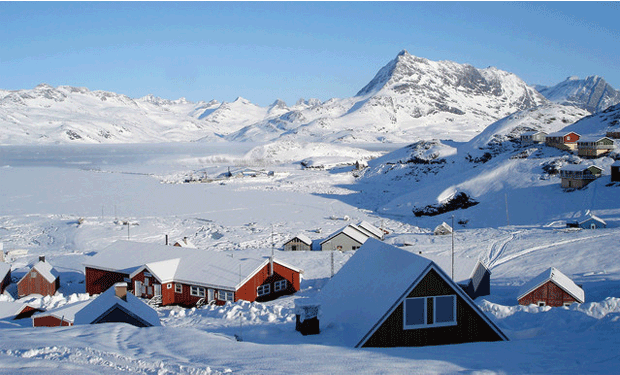
colonised the region for Denmark. Today the Qaanaaq District is home to
around 850 Inughuit. About 640 live in the main settlement of Qaanaaq, a
modern community of brightly coloured Scandinavian style wooden houses,
while the remainder live in the smaller villages of Savissivik,
Moriussaq, Qeqertat and Siorapaluk.
Daily Life
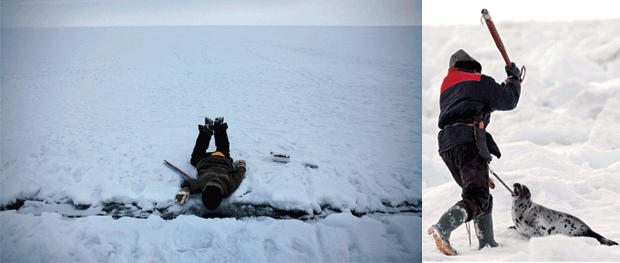
Sea mammal hunting and fishing remains the main occupation of the
Qaanaaq area although it is becoming increasingly difficult for hunters
to make ends meet. This is partly due to the US and EEC’s government ban
on import of seal skins which has led to collapse in the market price,
and also, the high cost of imported items that the Inughuit need. Like
in most other Inuit communities, the hunters in the Qaanaaq district
have evolved their own seasonal cycle. Seals are their main prey and are
hunted throughout the year. Walrus are caught mainly during the spring
and autumn when they migrate along the coast. Polar bears are normally
hunted in February March, both in Smith Sound and Melville Bay. They
also hunt Arctic hares, ptarmigan and trap foxes. During the brief
Arctic summer, the Inughuit hunt Narwhals and white whales. They also
catch fish, Greenland halibut in the winter, and arctic char, polar cod
and sculpins during the summer. During the spring and summer they also
catch Little Auks (Dovkies) and a variety of other sea birds.
|
|
 |
|
Language
The Inughuit speak ‘Inuktun,’ a dialect of the Inuit language
‘Inuktitut’ that is spoken around the Arctic from the north of Alaska to
Greenland. Most Inughuit also speak Danish which they are taught in
school.
Food
The traditional Inughuit diet consists mainly of sea mammals and fat.
Seal is the staple food, but they also eat polar bear, walrus, and whale
meat and skin, as well as migratory sea birds in the summer. Fish like
Greenland Halibut and Arctic Char also form part of their diet. Their
main delicacies are mattaq (whale skin) and Kiviat (fermented little
auks). Nowadays there is an increasing amount of Danish foods available
in the shops, but traditional food still remains very popular.
Transport
In the Qaanaaq district the dog sled still retains its role as the main
form of winter transport as hunting from snowmobiles is banned. During
the summer the kayak is also in still in common use here. Local hunting
regulations dictate that Narwhals which are hunted in Inglefield Bay
during the spring/summer must be caught in a traditional way using
kayaks and hand thrown harpoons. The community is serviced by
helicopters and small aircraft.
|
 |
|
Religion
In common with other Inuit communities around the Arctic, the Inughuit
traditionally had animist beliefs in which all living things have a
spirit. They believed that the whole universe was in harmony and the
powers of nature had a neutral disposition towards man. When evil things
happened, e.g. bad hunting or sickness, it was likely to be the result
of a person’s bad behaviour. Gods and spirits controlled nature, and the
Inughuit not only had to behave correctly, but also interpret the
mysterious ways of the spirits and deities in order to survive. This
interpretation and communication with the spirits was normally carried
out by an Angaqoq (Shaman). Although some of the traditional beliefs
linger on, nowadays most Inughuit are Christian and follow the Danish
Lutheran faith.
Clothing
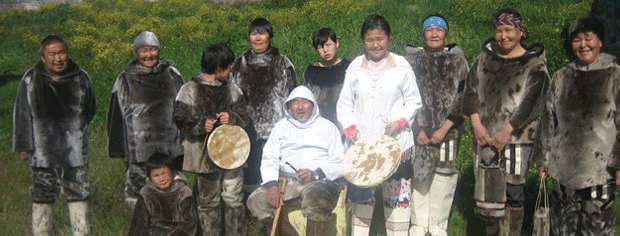
Both men’s and women’s traditional clothing was made from a combination
of the skins from the animals they hunted. Men wear kamik (boots) made
from sealskin and which is often worn with an Arctic Hare skin sock. Men
also wear trousers made from polar bear skin, which come down to the
knee, and a short caribou or sometimes fox skin hooded parka. Women’s
dress includes thigh length sealskin boots, short fox fur knickers and a
hooded jacket usually made from seal or Arctic fox skin. Nowadays most
people wear modern clothes at home in the community, but still wear some
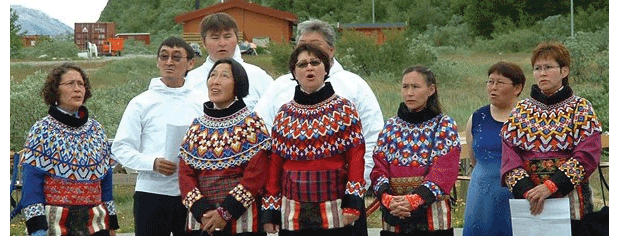
traditional clothing when they are out on hunts or at camps. On festive
occasions like confirmations, weddings & christenings most Inughuit
still wear traditional dress.
|
 |
|
Social & Other Problems
Nowadays few young men want to become hunters and even fewer young women
want to become hunter’s wives. With relatively few jobs available,
unemployment in the Qaanaaq district is high. This forces many young
Inughuit to look for jobs in towns in the south of Greenland, but many
experience difficulty settling outside of their own community and
return. Even for those who want to become hunters, it’s hard to make a
living and it is made all the more difficult by the often dangerous ice
conditions that have resulted from the warmer changing climate. Like in
many Arctic communities, problems with alcohol and drugs are common.
There is also a high suicide rate, particularly among young males, in
the Qaanaaq District.
|